
Documentation
Technical documentation for Persistent Infrastructure Identity.
Use Documentation to understand supported inputs, identity resolution, verification context, structured responses, geometry delivery, registry alignment, and enterprise integration.
Start with identity resolution
Submit a reference. Resolve the structure. Return persistent identity.
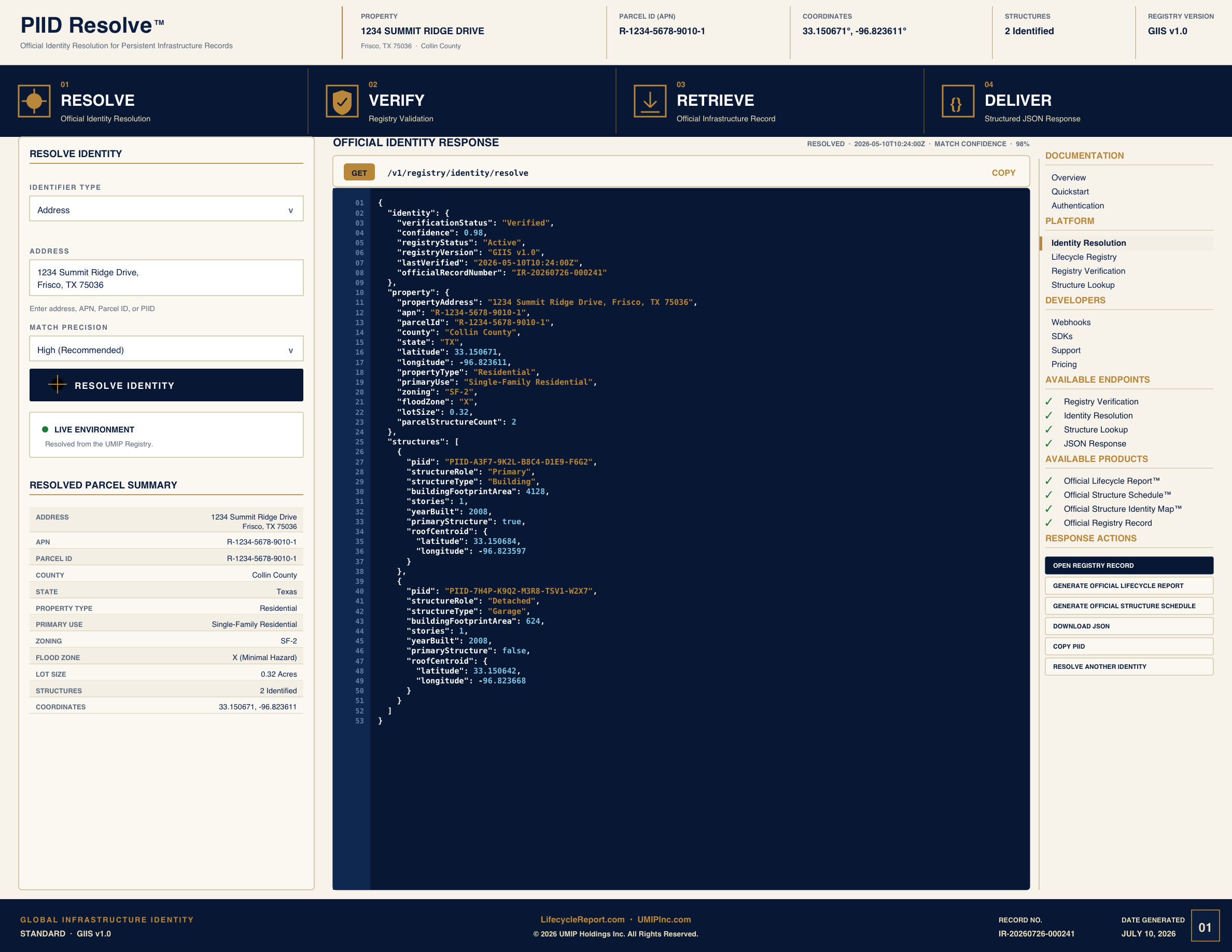
The PIID Resolve™ API accepts supported structure references and reconciles them to the physical structure represented by the request.
A structured JSON response returns the resolved PIID™, verification information, registry context, and supported property and structure information for direct enterprise use.
PIID Resolve™ API
Structure Identity Resolution
Resolve supported references to persistent infrastructure identity.
Supported Inputs
PIID Resolve™ can accept supported references including:
Normalized Address
Parcel
PIID™
Coordinates
Geometry
Supported Source Reference
Resolution
Submitted references are reconciled to the physical structure represented by the request.
Verification
Supported identity and registry context are evaluated as part of the resolution workflow.
Response
The resolved structure identity and supported context are returned through a consistent machine readable JSON response.
Which structure is it? PIID Resolve™ returns the persistent answer.
Built for machine readable integration.
PIID Resolve™ delivers supported identity and structure information through structured JSON responses designed for direct system integration.
Enterprise applications can use these responses within:
Data Platforms
Geospatial Systems
Risk Applications
Decision Engines
Analytics Environments
Enterprise Workflows
Automation
Artificial Intelligence
API delivered. Machine readable. Built for integration at scale.
Persistent identity in a consistent structure.
A supported PIID Resolve™ response can include:
Canonical PIID™
The persistent infrastructure identity of the resolved physical structure.
Verification Status
The supported verification state associated with the identity.
Registry Status
Supported status of the identity within UMIP Registry™.
Property Context
Supported property references associated with the resolved structure.
Structure Context
Supported structure information associated with the PIID™.
Resolution Confidence
Supported confidence context associated with the resolution result.
Source References
Supported references used within the identity resolution process.
Structured JSON
A consistent machine readable response for enterprise consumption.
Resolution is anchored to persistent registry identity.
UMIP Registry™ is the system of record for PIID™ identities, verification context, supported source relationships, structure references, and registry continuity.
PIID Resolve™ provides enterprise access to persistent structure identity maintained through that framework.
The Registry does not require every underlying provider dataset, enterprise database, or external source record to be stored within UMIP.
Existing systems retain their data. PIID™ provides the persistent structure reference.
Multiple references can describe the same structure.
Address Resolution
Reconciles supported normalized, postal, delivery, and legacy address references to structure identity.
Parcel Resolution
Reconciles supported parcel identifiers and property references to qualifying structures.
Structure Resolution
Resolves a supported structure reference to its persistent infrastructure identity.
PIID™ Resolution
Returns supported identity and registry context associated with an existing PIID™.
Coordinate Resolution
Reconciles supported geographic coordinates to identified physical structures.
Geometry Resolution
Uses supported spatial geometry to resolve the physical structure represented by the request.
Cross Reference Resolution
Reconciles supported enterprise identifiers, source keys, and external references to PIID™.
Different references. Same physical structure. One persistent identity.
Integrate identity into the systems already in place.
UMIP enterprise products are designed to operate within existing technology environments.
PIID Resolve™ can be integrated into applications, data platforms, geospatial environments, analytical systems, risk solutions, automation workflows, and other enterprise infrastructure.
Structured JSON responses support direct API workflows.
Supported file based JSON delivery can also be provided where enterprise exchange requirements call for it.
Your systems remain in place. Persistent identity becomes part of the workflow.
Connection does not require centralization.
Using PIID Resolve™ does not require organizations or data providers to migrate their underlying datasets or replace their existing systems.
External systems can retain their own records, identifiers, databases, and source relationships.
PIID™ provides the persistent structure reference through which supported information can coordinate around the same physical asset.
Persistent identity is foundational. Storage is optional.
Technical specification
PIID™ Format Specification
The canonical technical specification for PIID™ structure, syntax, and validation.
The PIID™ Format Specification defines the technical representation of Persistent Infrastructure Identity, including formatting requirements, syntax, and validation rules.
It serves as the technical identifier reference for systems that generate, validate, exchange, store, or reference PIID™ values.
Understand the systems behind the APIs.
PIID™
The persistent identity assigned to the physical structure.
Lifecycle™
The framework through which supported records, events, relationships, and history remain connected to persistent structure identity through time.
UMIP Registry™
The system of record for PIID™ identities, verification context, supported source relationships, and registry continuity.
PIID Resolve™
The enterprise product for resolving supported references to persistent structure identity.
Technical implementation sits within a governed identity framework.
GIIS™
The governance framework for Persistent Infrastructure Identity.
PIID™
The identity assigned to the physical structure, including verification, registry operations, and continuity.
UMIP Registry™
The system of record for PIID™ identities, verification context, and registry continuity.
For developers and enterprise teams
Build on persistent structure identity.
Use the technical documentation to understand supported identity workflows, request structures, response schemas, verification context, geometry delivery, and integration requirements.
GIIS™ and PIID™ provide the governance and identity concepts supporting that implementation.