
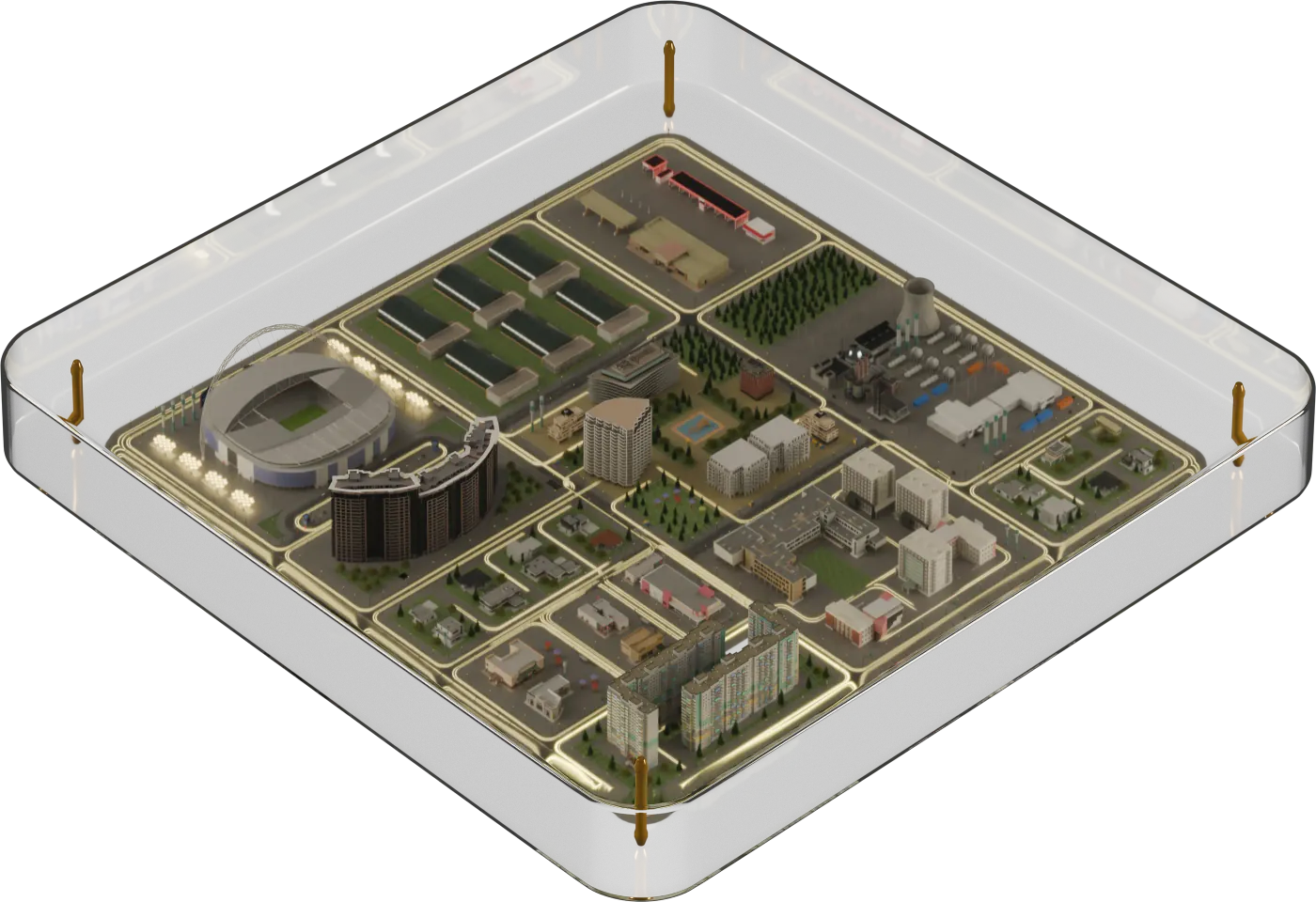
Smart Cities
One city.Many systems.One persistent structure identity.
Smart cities depend on information moving across systems that were never designed to share a common identity for the physical structures they manage.
Planning systems reference parcels.
Permitting systems reference addresses.
Utilities reference service locations.
Emergency systems reference incidents and coordinates.
GIS platforms reference geometry.
Digital twins maintain models.
Enterprise platforms create their own identifiers.
Smart Cities
Connect the systems that operate the city through persistent infrastructure identity.
PIID™ gives these environments a persistent way to reference the same physical structure.
The Urban Identity Problem
A connected city cannot operate on disconnected references.
Cities already generate enormous amounts of infrastructure information.
The challenge is not simply collecting more data.
It is knowing when information from different departments, systems, vendors, and time periods describes the same physical structure.
Without persistent structure identity, every integration can require another matching process.
Addresses must be reconciled.
Parcels must be interpreted.
Coordinates must be matched.
Building geometry must be compared.
Source identifiers must be translated.
PIID™ creates a persistent reference to the physical structure itself.
Smart city interoperability begins with identity.
- GIS
- Permit
- Utilities
- Emergency
- Planning
- Property
The Common Structure Reference
Different systems. Same city.Same physical asset.
A single structure can appear across planning, permitting, public safety, utilities, energy, property records, inspections, transportation, telecommunications, environmental systems, and digital twin environments.
Each system can maintain its own records.
PIID™ gives those systems a consistent way to reference the same physical structure.
Existing systems retain their role. Persistent identity becomes the connection point.
PIID Resolve™
Resolve fragmented city references to the structure itself.
PIID Resolve™ identifies, validates, and resolves supported addresses, parcels, coordinates, geometry, PIIDs™, and source references to persistent infrastructure identity.
This gives municipal systems, technology providers, data platforms, and urban applications a consistent structure reference wherever the same physical asset appears.
A planning system can retain its parcel reference.
A permitting platform can retain its permit records.
A GIS environment can retain its geometry.
A utility can retain its service identifiers.
PIID™ allows supported references to resolve around the same physical structure.
One persistent structure identity across city systems.
PIID Resolve™Cross System Interoperability
Smart cities need a reference layer, not another silo.
PIID™ is designed to complement existing city technology rather than replace it.
Government databases can remain.
GIS platforms can remain.
Utility systems can remain.
Permitting platforms can remain.
Emergency management systems can remain.
Digital twin environments can remain.
PIID™ provides the persistent physical structure reference through which supported systems can coordinate.
Connection does not require centralization.
City Operations
Persistent identity across the systems that operate the built environment.
PIID™ can support structure level continuity across municipal and urban workflows including planning, permitting, inspections, code enforcement, GIS, public works, utilities, emergency management, resilience, property administration, telecommunications, energy programs, and infrastructure analysis.
The objective is not to combine every city function into one system.
It is to give those functions a common reference to the physical infrastructure they share.
One city infrastructure layer. Many operational systems.
Digital Twins
The digital model should maintain the identity of the physical asset.
Digital twins can become increasingly sophisticated representations of buildings, districts, campuses, and cities.
But the digital representation and the physical asset are not the same thing.
Models can change.
Platforms can change.
Geometry can be updated.
Providers can change.
PIID™ provides a persistent identity for the physical structure behind the digital representation.
That identity can provide continuity between the real structure and supported digital twin environments as technology evolves.
The model can change. The physical structure identity persists.
Digital Twins and SimulationGIS and Location Intelligence
Move from location context to structure context.
Traditional geospatial systems are exceptionally good at answering where something is.
PIID™ adds another question.
Which persistent physical structure is it?
PIID Resolve™ allows supported geospatial references to connect location, geometry, and persistent structure identity.
This creates stronger continuity across GIS layers, imagery, mapping, planning systems, analytics environments, and urban applications.
Location tells you where. PIID™ tells you what persistent structure exists there.
GIS, Mapping and Geospatial IntelligenceEmergency Management and Resilience
The structure should not change identity when the event begins.
During severe weather, catastrophe events, emergency response, damage assessment, and recovery, multiple organizations can interact with the same physical structure.
PIID™ provides a persistent structure reference that can remain consistent before, during, and after the event.
Persistent identity can support clearer coordination across planning, response, assessment, recovery, and long term resilience workflows.
Before the event. During the event. After the event. Same structure identity.
Utilities and Energy
Connect urban infrastructure around the structures being served.
Electricity, water, gas, telecommunications, broadband, distributed energy, and other services can each maintain different references to the same location.
PIID™ provides a persistent structure identity that can help supported utility and energy systems coordinate around the physical asset receiving or interacting with those services.
This creates stronger structure context for service locations, planning, resilience, distributed energy, electrification, and urban infrastructure analysis.
The service can change. The structure identity remains.
Artificial Intelligence
AI needs persistent context for the physical world.
Smart city AI systems increasingly combine information from multiple urban data environments.
Without persistent identity, models and agents may repeatedly reconcile fragmented references before they can understand which physical asset the information describes.
PIID™ provides a consistent structure identity across supported records, geometry, events, and systems.
That gives AI a more persistent reference for understanding physical infrastructure through time.
Persistent identity creates persistent machine context.
Infrastructure Lifecycle
A city changes continuously.Structure identity should not.
Buildings are constructed.
Permits are issued.
Ownership changes.
Systems are upgraded.
Utilities change.
Inspections occur.
Damage is repaired.
Technology evolves.
Lifecycle™ provides the framework through which supported records, events, relationships, and history can remain connected to the same persistent structure identity through those changes.
One physical asset across decades of urban change.
Lifecycle™Multi Structure Environments
Cities operate more than individual buildings.
Campuses, multifamily properties, government complexes, industrial sites, transportation facilities, institutional properties, and large commercial parcels may contain multiple qualifying structures.
UMIP Structure Schedule™ is being developed to document those structures individually through PIID™, location, geometry, and parcel relationship.
This creates clearer structure level context within complex urban environments.
One property can contain many structures. Each structure can maintain its own identity.
Coming Soon
In development
Enterprise Integration
Built for the technology environments cities already use.
PIID Resolve™ is designed for integration into municipal platforms, GIS environments, data systems, digital twins, enterprise applications, analytics environments, operational platforms, and AI workflows.
Structured JSON responses enable machine readable identity and geometry delivery.
Supported file based delivery can also support applicable enterprise exchange requirements.
API delivered. Machine readable. Built for integration at scale.
Data Control
Interoperability without surrendering existing systems.
Cities, agencies, technology providers, utilities, and data partners do not need to migrate all underlying information into UMIP in order to use persistent infrastructure identity.
Existing systems can retain their data, records, identifiers, and operating environments.
PIID™ provides the persistent reference through which supported information can coordinate around the same physical structure.
Your systems remain in place. Identity becomes interoperable.
Governed by GIIS™
Connected cities require consistent identity.
Urban interoperability becomes more valuable when the same identity principles can operate consistently across agencies, providers, jurisdictions, and technology environments.
GIIS™ establishes the governance framework for how Persistent Infrastructure Identity is assigned, referenced, resolved, and maintained.
PIID™ provides the structure identity.
GIIS™ provides the governance foundation supporting its consistency.
Identity creates the reference. Governance protects its continuity.
Built on UMIP
The identity foundation for connected urban infrastructure.
PIID™
Persistent identity for the physical structure.
PIID Resolve™
Resolves fragmented references to persistent structure identity.
Lifecycle™
Maintains continuity around the structure identity through time.
UMIP Registry™
Maintains persistent infrastructure identity and supported registry context.
UMIP Structure Schedule™
Documents qualifying structures within complex properties and environments.
Coming Soon
In development
At Scale
Persistent identity for the connected city.
- 189M+PIIDs Registered Across the United States
Persistent Infrastructure Identity already exists at national scale.
The opportunity for smart cities is to use that identity foundation to create stronger interoperability among the systems responsible for understanding, operating, protecting, and improving the built environment.
Identity → Interoperability → Connected Infrastructure Intelligence
Related
Resolve physical structures to persistent infrastructure identities. PIID Resolve™ identifies, validates, and resolves structures from addresses, parcels, coordinates, geometry, and supported source records.
A smarter city begins with knowing which physical asset every system is talking about.
The future of urban technology will involve more systems, more sensors, more data, more automation, more digital twins, and more artificial intelligence.
Those systems become more useful when they can share a persistent reference to the physical infrastructure they describe.
One city. Many systems. One persistent structure identity.