
Registry™
The system of record for persistent infrastructure identity.
The system of record for persistent infrastructure identity.
UMIP Registry™ maintains PIID™ identities, verification context, supported source relationships, structure references, and registry continuity across systems and through time.
One structure. One persistent identity. One trusted registry reference.
- 189M+PIIDs Registered Across the United States.
Persistent identity requires a persistent system of record.
An identifier only becomes useful infrastructure when its relationship to the physical asset can remain consistent.
UMIP Registry™ provides that continuity for PIID™.
The surrounding records can change. The registered identity persists.
Identity cannot remain persistent if every system defines it independently.
Addresses change in format.
Parcel references vary by jurisdiction.
Coordinates can change in precision.
Data providers maintain their own identifiers.
Enterprise systems create internal keys.
Organizations and technology environments evolve.
PIID™ provides the persistent structure identity.
UMIP Registry™ maintains the registry foundation that allows that identity to remain consistent across those changing environments.
Persistence requires continuity. The Registry provides it.
One platform. Three foundational layers.
Foundation
PIID™
Establishes the persistent identity of the physical structure.
Record Framework
Lifecycle™
Establishes how supported records, attributes, events, relationships, and history remain connected to that identity through time.
System of Record
UMIP Registry™
Maintains PIID™ identities, verification context, supported source relationships, structure references, and registry continuity.
The infrastructure behind persistent identity.
PIID™ Registration
Registers a persistent infrastructure identity for a verified physical structure.
Identity Verification
Validates the relationship between PIID™ and the physical structure it represents using supported authoritative source references.
Registry Search
Enables supported search and discovery across registered PIIDs™, structures, and associated registry context.
Structure Records
Maintains the registry level identity context associated with each registered physical structure.
Source Relationships
Maintains supported references connecting PIID™ to the external identifiers, systems, and records used to resolve and verify the structure.
Registry Continuity
Preserves the relationship between the physical structure and its PIID™ as surrounding records, systems, ownership, and organizations change.
Lifecycle References
Maintains supported references to lifecycle events and context associated with the persistent structure identity.
Identity Lineage
Maintains the supported registry history required to understand identity continuity through time.
Registration. Verification. Resolution. Continuity.
One physical structure.One persistent identity.
PIID™ registration establishes the persistent infrastructure identity associated with the physical structure.
Once registered, the PIID™ becomes the consistent structure reference used throughout supported UMIP products and identity workflows.
Identity is assigned to the structure, not to the system describing it.
Persistence requires confidence in what the identity represents.
UMIP Registry™ maintains supported verification context associated with the binding between PIID™ and the physical structure.
Verification can incorporate supported authoritative source references, property context, location, geometry, structure information, and other qualifying signals used within the identity framework.
The objective is simple:
One PIID™ should continue to represent the same physical structure through time.
Different identifiers can reference the same structure.
A county system may reference a parcel.
A postal system may reference an address.
A lender may reference collateral.
An insurer may reference a policy.
A geospatial provider may reference geometry.
An enterprise platform may maintain its own internal key.
UMIP Registry™ can maintain supported relationships between those references and the persistent PIID™ of the physical structure.
Different references. Same structure. One persistent identity.
The registry preserves identity through change.
A physical structure may experience decades of change.
Ownership changes.
Address normalization changes.
Parcel relationships can change.
Systems are replaced.
Providers change.
Records accumulate.
PIID™ remains the persistent structure identity.
UMIP Registry™ maintains the registry continuity that allows supported systems to continue resolving back to the same physical asset.
The environment changes. The identity remains.
Resolution reads identity from the registry foundation.
PIID Resolve™ identifies, validates, and resolves supported references to persistent infrastructure identities.
Addresses, parcels, coordinates, geometry, PIID™, and supported source records can resolve to the same physical structure.
UMIP Registry™ provides the persistent identity foundation against which that resolution is established and verified.
PIID Resolve™ answers which structure it is. UMIP Registry™ maintains the identity that answer resolves to.
Explore PIID Resolve™Identity becomes more valuable when continuity extends through time.
Lifecycle™ is the record framework through which supported records, attributes, events, relationships, and history remain connected to PIID™.
UMIP Registry™ maintains the persistent identity and supported registry context underlying that continuity.
The Registry does not need to become the source system for every lifecycle record.
It provides the persistent structure identity around which supported references and context can remain coordinated.
Identity persists. Lifecycle context connects around it.
Lifecycle™The Registry is not a data warehouse
Persistent identity does not require centralizing every dataset.
UMIP Registry™ is the system of record for persistent infrastructure identity.
It does not require every underlying provider dataset, external source record, enterprise database, or customer system to be copied into UMIP.
Data providers remain the source of their own information. Organizations retain their existing systems, records, identifiers, licensing environments, and data architectures.
The Registry maintains the persistent identity and supported relationships required to resolve information to the same physical structure.
Your data remains your data. Connection does not require centralization.
The registered structure is the unit of identity.
Each registered structure maintains a persistent PIID™ and supported registry context.
That context can include:
PIID™
Registry Status
Verification Status
Structure References
Supported Property Context
Supported Source Relationships
Supported Geometry References
Lifecycle References
Identity Lineage
The Registry maintains the continuity of the identity without requiring every associated external record to become a Registry record.
The Registry connects identity without replacing existing systems.
Government systems can retain government records.
Insurers can retain insurance records.
Lenders can retain lending records.
Utilities can retain operational systems.
Property platforms can retain their own data environments.
Technology providers can retain their proprietary identifiers.
PIID™ provides the persistent structure reference.
UMIP Registry™ maintains the identity continuity behind that reference.
Different systems retain their role. The Registry maintains the identity connection.
Persistent identity infrastructure for an increasingly connected world.
For people, the Registry provides continuity around the structure identity.
For enterprise systems, it provides a consistent structure reference.
For AI, it provides persistent physical asset identity across changing data sources and time.
One identity foundation across human and machine systems.
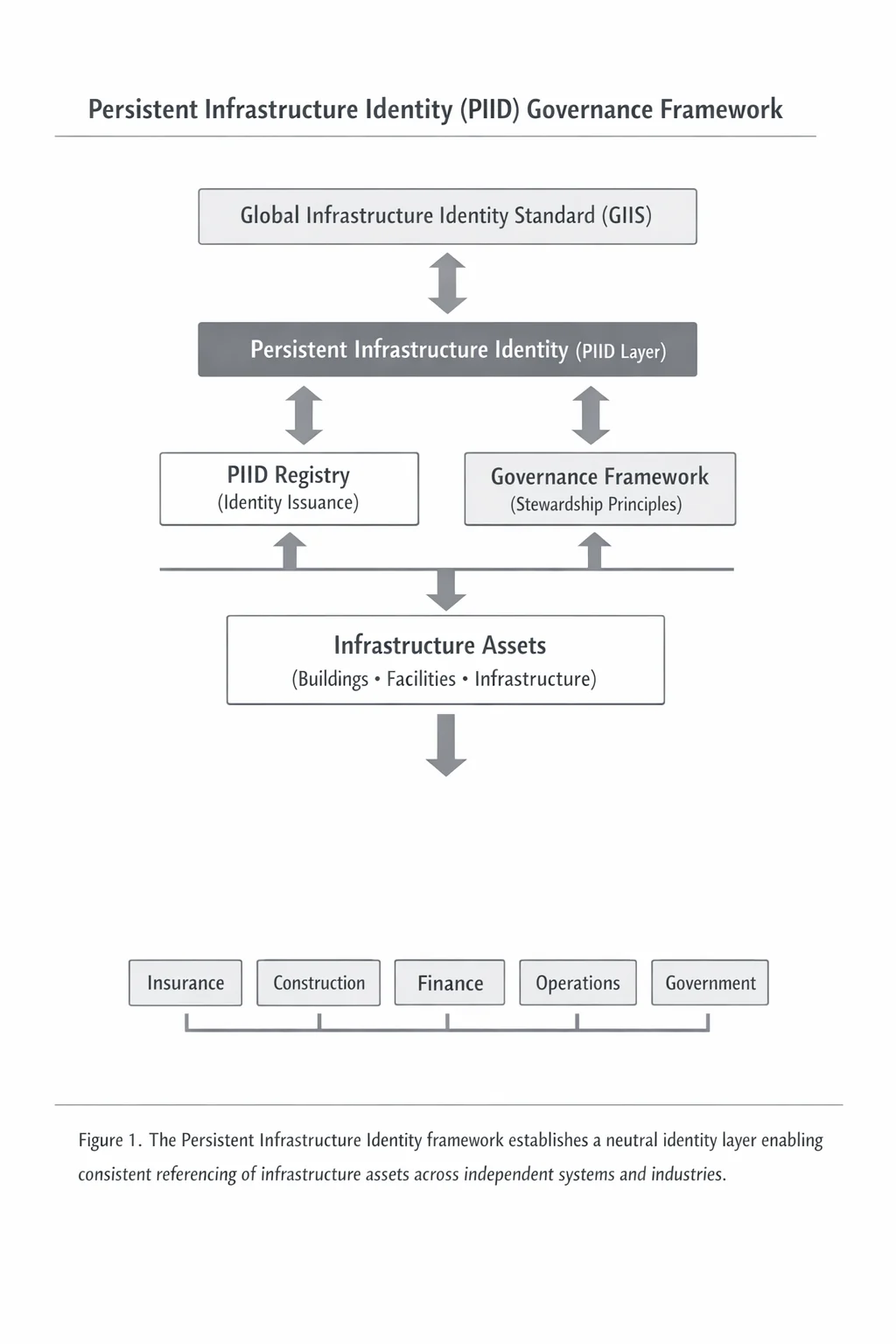
Registry continuity requires consistent governance.
GIIS™ establishes the governance framework for how persistent infrastructure identity is assigned, resolved, referenced, verified, and maintained.
UMIP Registry™ operates within that identity framework to maintain consistency as PIID™ adoption expands across organizations, systems, industries, and jurisdictions.
Governance protects the integrity of the identity layer.
The framework behind persistent registry identity.
The PIID™ Governance and Registry Framework defines the relationship among GIIS™, PIID™, registry operations, verification, stewardship, infrastructure assets, and participating sectors.
It establishes the principles required for persistent structure identity to remain consistent across systems and through time.
Persistent infrastructure identity, registered at national scale.
- 189M+PIIDs Registered
Persistent Infrastructure Identities registered across the United States.
PIID™ Registration
Persistent identity for qualifying physical structures.
Identity Verification
Supported verification of the relationship between PIID™ and the physical structure.
Registry Continuity
Identity that remains consistent as surrounding systems and records change.
Enterprise Resolution
Persistent identity accessible through PIID Resolve™ and supported enterprise workflows.
GIIS™ Governance
Consistent rules for persistent infrastructure identity.
Persistent Infrastructure Identity in the public record.
Independent industry coverage documents the emergence of persistent infrastructure identity across engineering, technology, construction, property, government, and the broader infrastructure economy.
Facility Executive · 2026-08-11
What The Former Pfizer HQ Failure Should Make You Ask About Your FacilityIndependent coverage in Facility Executive.
Digital Construction · 2026-08-07
The built environment has an identity crisisIndependent coverage in Digital Construction.
CCR-Mag · 2026-08-04
The Built Environment Is Missing an Identity LayerIndependent coverage in CCR-Mag.
Give your systems a persistent reference to the physical structure.
PIID Resolve™ provides enterprise access to structure identity maintained through the UMIP Registry™ framework. Resolve supported references, verify structure identity, and return persistent infrastructure identity through structured enterprise delivery.