
PIID™
The persistent identity for physical infrastructure.
Persistent Infrastructure Identity, PIID™, gives every qualifying physical structure a globally unique identity designed to persist for the life of the asset.
PIID™ does not depend on any single dataset, jurisdiction, organization, or vendor.
One structure. One persistent identity.
- 189M+PIIDs Registered Across the United States.
What PIID™ is
The structure's own identity.
Not An address
Not A parcel number
Not A coordinate
Not Vendor specific property ID
A persistent identifier assigned to the physical structure itself.
Globally unique. Assigned per structure. Preserved for the life of the asset.
Why PIID™ exists
Infrastructure has always been identified by proxies.
Addresses describe locations.
Parcels describe land.
Coordinates identify positions.
Permits identify events.
Policies identify insurance relationships.
Loans identify financial relationships.
None of them persistently identifies the physical structure itself.
PIID™ establishes the structure as the reference point.
The reference can change. The structure identity persists.
One structure across every system
Different systems.Same physical asset.
A government system may reference a parcel.
A postal system may reference an address.
An insurer may reference a policy.
A lender may reference a loan.
A utility may reference a service location.
A geospatial platform may reference geometry.
PIID™ gives those systems a persistent way to reference the same physical structure.
One persistent reference across sectors and systems.
Persistence through time
The systems surrounding infrastructure will change.
A structure may be constructed, purchased, insured, financed, renovated, inspected, repaired, operated, transferred, and eventually retired.
The organizations involved can change.
The systems can change.
The records can change.
The identifiers surrounding the asset can change.
PIID™ remains associated with the same physical structure.
Identity that persists through the lifecycle of the asset.
Identity before data
More data does not solve identity.
The built environment already produces enormous volumes of information.
The problem is that the information does not always share a persistent reference to the physical structure it describes.
PIID™ creates that reference.
Once structure identity is established, supported records, geometry, events, systems, and intelligence can coordinate around the same physical asset.
Identity before data.
Trust before automation.
Interoperability by design.
How PIID™ fits the platform
One platform.Three foundational layers.
PIID™
Foundation
Establishes the persistent identity of the physical structure.
Lifecycle™
Record Framework
Establishes how supported records, attributes, events, and history remain connected to that structure identity through time.
UMIP Registry™
System of Record
Maintains PIID™ identities, verification context, supported source relationships, and registry continuity.
PIID Resolve™
Resolve fragmented references to persistent identity.
PIID Resolve™ identifies, validates, and resolves physical structures to PIID™.
Addresses, parcels, coordinates, geometry, and supported source references can resolve to the same physical structure, giving enterprise systems a consistent identity reference across systems and through time.
Know which structure it is. Persistently.
Interoperability
PIID™ does not require the world to adopt one database.
Existing systems can continue to maintain their own records, identifiers, applications, and data environments.
Interoperability does not require every organization to operate the same technology stack.
Different systems retain their role. Identity becomes the connection point.
Built for machines and people
A persistent reference for the infrastructure economy.
For people, PIID™ provides a clear way to reference the structure.
For software, it provides a consistent machine readable identity.
For AI, it provides persistent physical asset context across data sources and time.
One structure identity for an increasingly connected infrastructure ecosystem.
Governed by GIIS™
Persistent identity requires consistent rules.
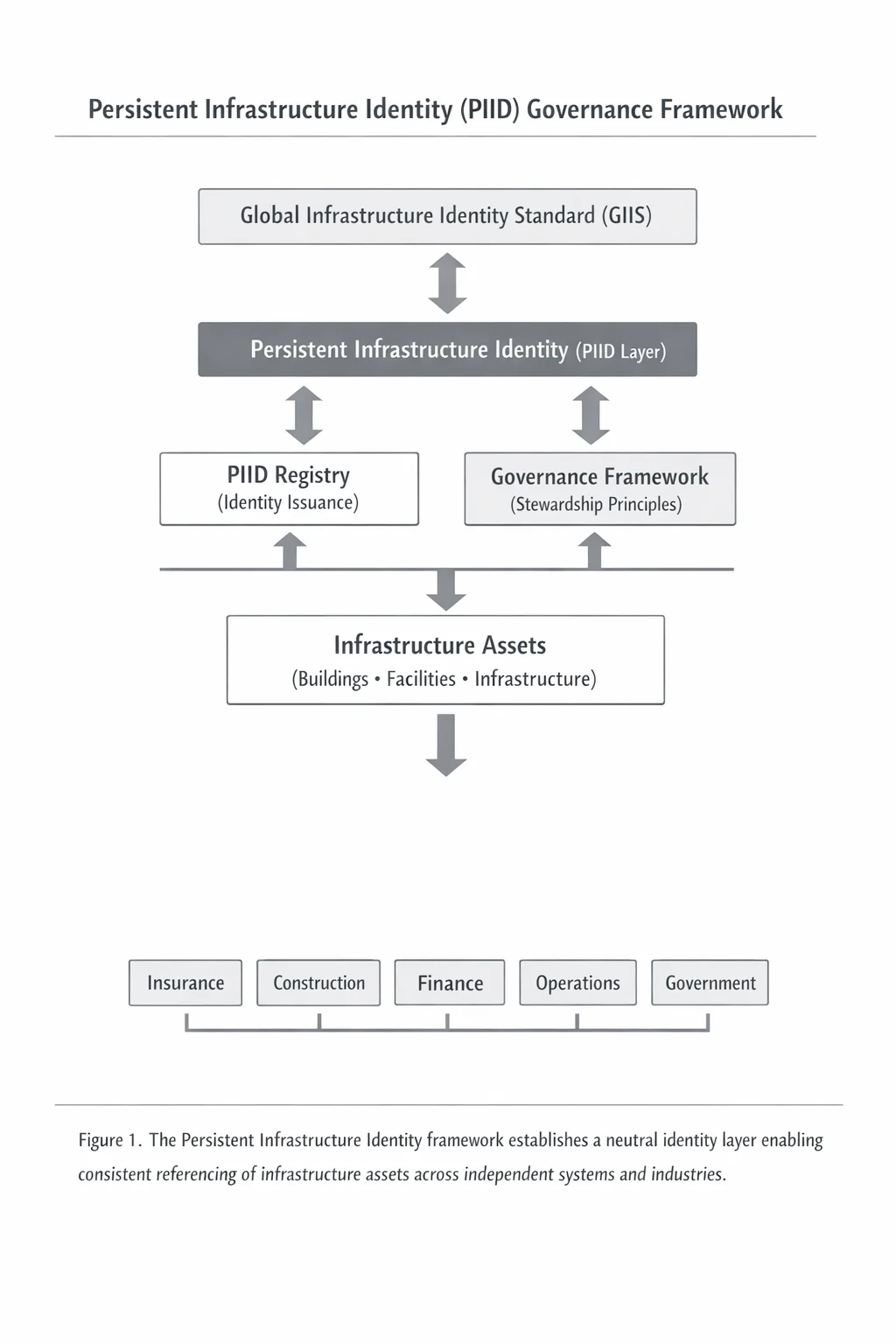
The Global Infrastructure Identity Standard, GIIS™, establishes the governance framework for how infrastructure identity is assigned, referenced, resolved, and maintained.
GIIS™ provides the consistency required for PIID™ to remain useful across organizations, systems, industries, and time.
Governance and stewardship
Identity designed for continuity.
The PIID™ Governance and Registry Framework defines the relationship among GIIS™, PIID™, registry operations, stewardship principles, infrastructure assets, and participating sectors.
The framework establishes how persistent infrastructure identity can remain consistent while supporting adoption across public, private, and machine environments.
The lineage of persistent identity
Important systems become more interoperable when important objects have identity.
Vehicles have VINs.
Published works have ISBNs.
Internet systems use persistent addressing and naming standards.
Global navigation relies on common coordinate systems.
Physical infrastructure has historically lacked an equivalent persistent structure identity.
PIID™ establishes that missing reference for the built environment.
At scale
Persistent infrastructure identity, operational.
- 189M+PIIDs Registered
Persistent Infrastructure Identities registered across the United States.
One Structure
One persistent identity assigned to the physical asset.
Across Systems
Designed to provide a common structure reference across existing environments.
Through Time
Preserved for the life of the asset.
Governed by GIIS™
Consistent rules for persistent infrastructure identity.
In the record
Independent industry coverage documents the emergence of Persistent Infrastructure Identity across engineering, construction, technology, government, energy, property, and the broader infrastructure economy.
Digital Construction · 2026-08-07
The built environment has an identity crisisIndependent coverage in Digital Construction.
CCR-Mag · 2026-08-04
The Built Environment Is Missing an Identity LayerIndependent coverage in CCR-Mag.
Mecklenburg Times · 2026-07-30
Why your building's address was never meant to be its identityIndependent coverage in Mecklenburg Times.
Explore PIID™
Give the physical structure an identity that persists.
Read the technical documentation, study the governance framework, or contact UMIP to discuss enterprise integration.