
The Identity Layer for Infrastructure.™
PIID™ gives every structure a persistent identity,
creating a common
reference that enables existing
systems and identifiers to interoperate
around the
same physical asset.
- One identityPer structure
- InteroperabilityWithout replacementEXISTING IDs STAY IN PLACE
- One referenceAcross every system
- One identityPer structure
- InteroperabilityWithout replacementEXISTING IDs STAY IN PLACE
- One referenceAcross every system
- 189M+PIIDs Registered
- 27Industries
- VerifiedBuilt to Scale
- InteroperableBy Design
Powered by PIID™, UMIP gives every infrastructure asset a persistent identity, enabling every sector, organization, and system to reference the same asset in the same way.
The problem
The world’s infrastructure has no identity.
Everything valuable carries a permanent identity.
Everything except the built world.
A PERSON
IDENTITY
An identity established early in life and referenced across institutions, records, and systems.
A VEHICLE
VIN 1HGCM82633A004352
A permanent identifier assigned at the factory that persists across ownership, registration, and sale.
A STRUCTURE
NO PERSISTENT IDENTIFIER
The most valuable asset most people will ever own has no persistent identity and no permanent record.
Identity continuity
Different systems.
One identity per structure.
A persistent reference resolves records without replacing them.
The built worldalready has references.
The built world already has references.
Parcel IDs identify land parcels. Addresses point to locations. Permit, policy, and loan numbers identify individual records. Each serves a different purpose.
- Land
- County Assessor
PARCEL 0491-022-113 - Location
- Postal Service
4413 OAKRIDGE AVE - Records
- City Permits · Insurer · Lender
No persistent identity for each structure
Source references Five systems, seven physical structures
- County Assessor
PARCEL 0491-022-113 - Postal Service
4413 OAKRIDGE AVE - City Permits
PERMIT B-2019-4471 - Insurer
POLICY HO-8802-441 - Lender
LOAN 002-8841-3
Across the built environment, critical systems still rely on identifiers that were never designed to persist with the infrastructure itself. The result is fragmented records, unresolved assets, and downstream systems operating without a common reference layer.

Without identity.
Records remain fragmented.
Automation breaks across systems.
AI lacks persistent asset context.
Infrastructure cannot become truly interoperable.
The solution
One Identity.Across Every Sector.Across Every System.
PIID™ gives every system a persistent reference to the same physical structure, enabling interoperability across organizations, industries, and time.
ASSIGNED ONCE
A structure receives a single PIID™.
PERMANENT
Its identity persists for the life of the asset.
INDEPENDENT
It is not dependent on any single dataset, jurisdiction, or vendor.
More data won’t solve an identity problem.
PIID™ establishes a persistent identity layer that allows data, records, systems, and software to reference the same physical structure across its lifecycle.
Identity before data.
Trust before automation.
Interoperable by design.
Persistent Infrastructure Identity (PIID™) gives every structure a reference point that persists across ownership, organizations, systems, and decades of change. Lending, insurance, construction, government, digital twins, and AI can reference the same physical asset with certainty.
When identity persists, records connect. Systems interoperate. Infrastructure becomes intelligible across its lifecycle.
How it works
From property referenceto connected lifecycle.
Start with the references the built world already uses. Resolve the qualifying structures. Establish persistent identity. Connect records and lifecycle events to the same physical asset through time.
THE PROPERTY
Start with the existing references.
A parcel defines the land. An address describes its location. These are references existing systems already use.
THE STRUCTURES
Identify the physical assets.
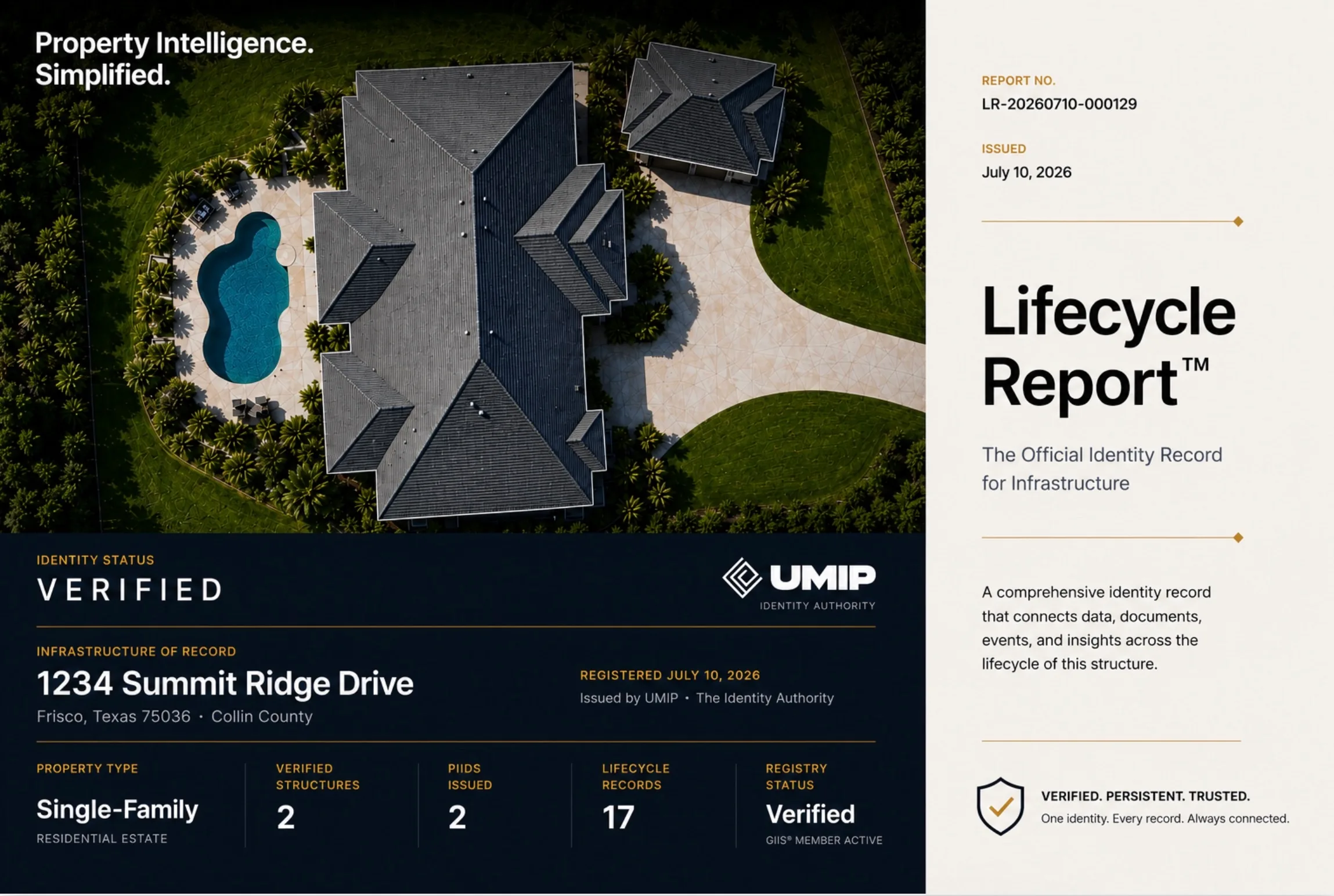
Each qualifying structure is referenced through its own PIID™, creating a persistent identity for the physical asset itself.
THE RECORDS
Connect systems through identity.
Different systems retain their own records and identifiers while PIID™ gives them a persistent way to reference the same physical structure.
THE LIFECYCLE
Maintain continuity through time.
Supported permits, policies, loans, inspections, improvements, and other lifecycle events remain connected to the same persistent structure identity as circumstances change.
One structure identity.Across systems. Through time.
Shared property context. Distinct structure identities.
- 01
Tower
Persistent structure identity
PIID-A47F-9C21-B8E3-6D0A-1F52Connected record examples
- Purchase
- Upgrade
- Storm event
- Insurance
- Inspection
- Permit
- Appraisal
- 02
Stepped building
Persistent structure identity
PIID-3D08-6B15-C742-9E30-5A81Connected record examples
- Maintenance
- Warranty
- Sale
PROPERTY REFERENCES
Address + Parcel
QUALIFYING STRUCTURES
Structure 01 → PIID™
Structure 02 → PIID™
CONNECTED SYSTEMS
Insurance · Lending · Government · Utilities · Transactions
LIFECYCLE CONTINUITY
Events and records connected through time
INFRASTRUCTURE INTELLIGENCE
When identitypersists, infrastructurebecomes intelligible.When identity persists,infrastructure becomes intelligible.
PIID™ gives systems a persistent reference to the same physical structure. Lifecycle™ keeps supported records, events, relationships, and history connected to that identity through time.
Together, they turn fragmented infrastructure information into connected intelligence that can be understood across systems, sectors, and the life of the asset.
189M+
PIIDs Registered Across the United States
PERSISTENT STRUCTURE IDENTITY
Every qualifying structure receives its own PIID™, creating a persistent reference to the physical asset itself.
CROSS SYSTEM INTEROPERABILITY
Different systems retain their own records and identifiers while referencing the same physical structure through PIID™.
LIFECYCLE CONTINUITY
Supported records, events, relationships, and history remain connected to the same structure identity through change.
THE RESULT
CONNECTED INFRASTRUCTURE INTELLIGENCE
Identity and continuity create a consistent structure context that can support decisions, analytics, automation, and AI across the infrastructure ecosystem.
Platform
The platform behind the identity layer.
One platform. Three foundational layers. Governed by GIIS™.
UMIP establishes the operating foundation for persistent infrastructure identity. PIID™ identifies the structure. Lifecycle™ defines how its record is organized through time. UMIP Registry™ preserves the identity, relationships, lineage, and verified events that allow systems to reference the same physical asset consistently.
Together, these layers create the foundation for interoperability, automation, lifecycle continuity, and intelligent infrastructure systems.
Foundation
PIID™
The persistent identity for infrastructure.
Globally unique. Assigned to the structure itself. Preserved for the life of the asset.
PIID™ does not depend on any single dataset, jurisdiction, organization, or vendor. It gives systems a persistent reference to the same physical structure across records, ownership, organizations, and time.
One structure. One persistent identity.
Record Framework
Lifecycle™
The framework for continuity through time.
Lifecycle™ establishes how attributes, records, events, and history remain connected to a persistent structure identity throughout the life of the asset.
Permits, inspections, policies, transactions, improvements, and other verified lifecycle events can remain associated with the same structure as systems, ownership, and conditions change.
A continuous record built around the identity of the asset.
System of Record
UMIP Registry™
The trusted system of record for infrastructure identity.
UMIP Registry™ preserves PIID™ identities, source relationships, lifecycle records, verification history, and the references required to resolve infrastructure consistently across systems.
It supports the capabilities required to register, resolve, verify, search, connect, and preserve infrastructure identity at scale.
The persistent memory of the infrastructure identity layer.
Registry Capabilities
UMIP Registry™
Identity becomes valuable when it can persist, resolve, connect, and carry context through time.
Governed by GIIS™
Identity requires rules.
The Global Infrastructure Identity Standard establishes the governance framework for persistent infrastructure identity, creating consistency in how infrastructure is identified, referenced, resolved, and maintained across organizations and systems.
GIIS™ protects the integrity of the identity layer as adoption expands.
The Operating Model
01
Identify the structure.
Establish its persistent infrastructure identity.
02
Connect its lifecycle.
Associate records, relationships, and verified events with the same identity through time.
03
Preserve its continuity.
Maintain the identity and its connected context within UMIP Registry™ for the life of the asset.
Enterprise Product
Enterprise infrastructure begins with identity.
UMIP provides enterprise systems with persistent structure identity through PIID Resolve™.
It establishes a consistent reference to the physical structure across systems, datasets, organizations, and workflows.
189,000,000+
PIIDs Registered
Persistent infrastructureidentities across theUnited States and growing.Persistent infrastructure identities across the United States and growing.
Verified
Authoritative source references.
Persistent
One structure. One identity.
Interoperable
Connect across systems and sectors.
Secure
Built for enterprise workflows.
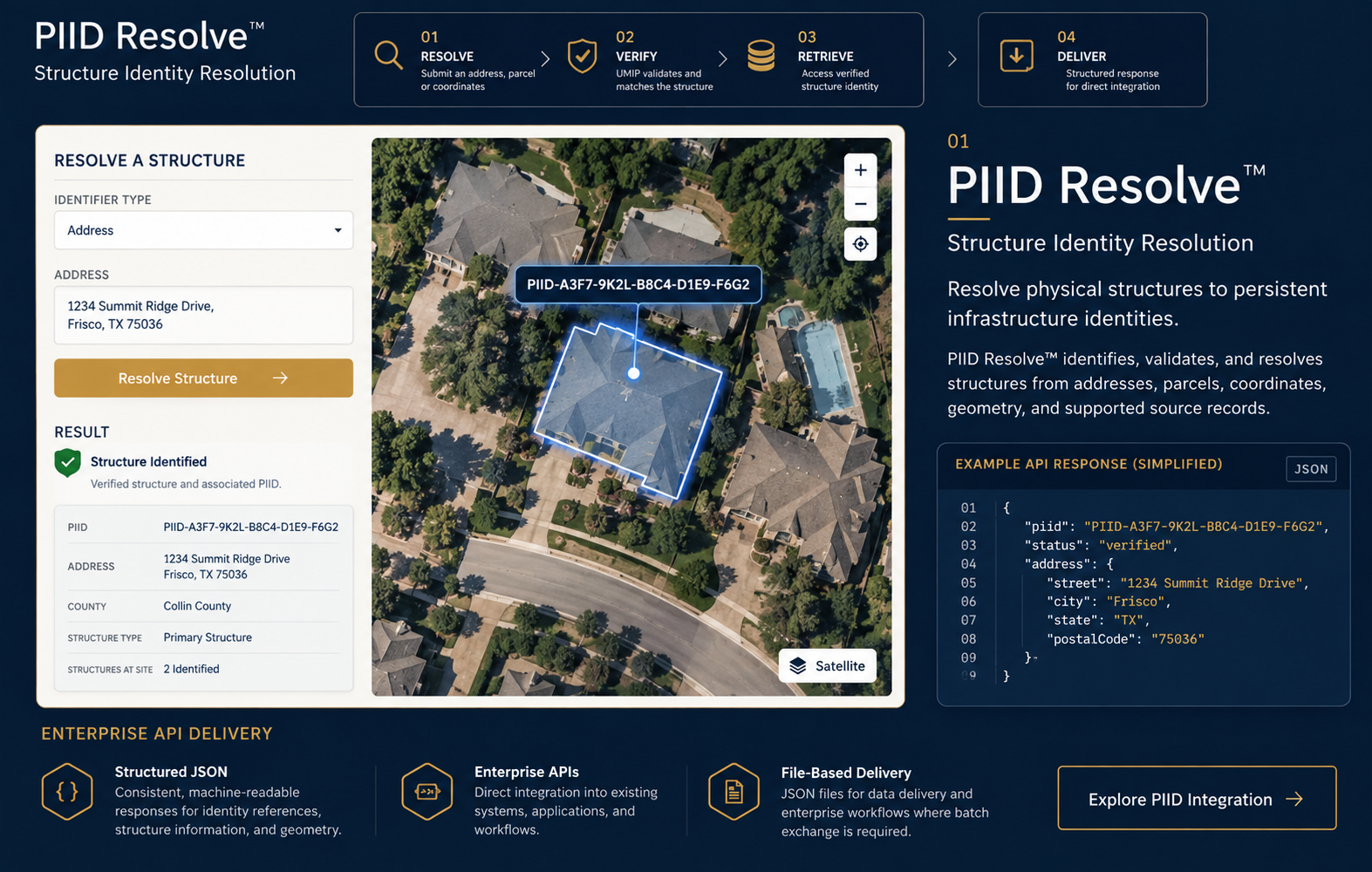
PIID Resolve™
Structure Identity Resolution
PIID Resolve™ identifies, validates, and resolves physical structures to persistent infrastructure identities.
Instead of relying on addresses, parcels, coordinates, geometry, or source identifiers independently, PIID Resolve™ reconciles supported records to the same physical structure through PIID™, creating continuity across systems, datasets, workflows, ownership changes, and time.
Enterprise systems receive a consistent structure identity that can connect records, reduce duplication and matching errors, improve data quality, and maintain a persistent reference to the same physical asset wherever it appears.
Know which structure it is. Persistently.
189M+ Persistent Infrastructure Identities Registered Across the United States.
Enterprise Delivery
Built for directsystem integration.Built for direct system integration.
PIID Resolve™ is delivered through enterprise APIs using structured JSON responses, allowing technical teams to integrate persistent structure identity directly into existing applications, data platforms, analytics environments, decision engines, and enterprise workflows.
Structured JSON delivery provides a consistent machine readable format for identity references, structure information, source relationships, and applicable registry intelligence.
JSON files can also support data delivery and enterprise workflows where file based exchange is required.
API delivered. Machine readable. Built for integration at scale.
Enterprise API Delivery
Structured JSON
A consistent machine readable format for identity references, structure information, and geometry.
Enterprise APIs
API endpoints for direct integration into existing systems, applications, and workflows.
File Based Delivery
JSON files for data delivery and enterprise workflows where file based exchange is required.
Sample JSON Response
JSON
- 01{
- 02 "piid": "PIID-A3F7-9K2L-B8C4-D1E9-F6G2",
- 03 "status": "verified",
- 04 "structure": {
- 05 "type": "Primary Structure"
- 06 }
- 07}
Built for Enterprise Workflows
Resolve
Submit an address, parcel, coordinates, geometry, or supported source reference through the API to identify the physical structure.
Verify
Validate structure identity and continuity across authoritative source references.
Connect
Connect persistent identity with structure geometry, records, relationships, and lifecycle context.
Deliver
Return structured JSON responses through the API for direct integration into enterprise systems, applications, data pipelines, analytics, and automated workflows.
Industries
The industries that operate the built world, aligned through one identity.
Every industry sees infrastructure through a different system. PIID™ gives them a persistent way to reference the same physical structure.
PIID™ connects structure identity across the systems, records, workflows, and decisions that depend on the built environment.
One structure. One identity. Across every industry.
PIID™ creates a persistent reference for the physical infrastructure that industries finance, insure, regulate, operate, analyze, build, and protect.
At Scale
Infrastructure identity, operational.
Persistent identity at national scale. Governed architecture. Products built for deployment across systems, workflows, and industries.
189M+
PIIDs Registered
Persistent infrastructure identities across the United States.
3
Foundational Layers
PIID™. Lifecycle™. UMIP Registry™.
3
Platform Products
Built across enterprise and lifecycle workflows.
4
Foundational Record Types
Identity. Structure. Location. Lifecycle.
27
Published Industries
Identity infrastructure across the built economy.
6
Resolution Inputs
Multiple references resolved to one physical structure.
Governed by GIIS™
Consistent infrastructure identity across systems, organizations, and sectors.
One identity.One standard.Interoperable by design.

The Identity Authority™
One Identity Layer
PIID™ creates a permanent, interoperable identity for every structure and asset.
Verified & Connected
We connect trusted partners and public records to deliver verifiable intelligence.
Infinite Impact
Powering better decisions across insurance, real estate, government, finance, and every industry.
In the Record
Persistent Infrastructure Identity is entering the industry conversation.
Independent coverage across insurance, engineering, energy, real estate, construction, facilities, manufacturing, and the broader infrastructure economy.


New Framework Assigns a Unique ID to Every Structure
EC MagazineJul 15, 2026
Read Article

The built environment has an identity crisis
IREIAug 7, 2026
Read Article

Viewpoint: The Missing Link in Commercial? No Paper Trail is Costing Insurers
Insurance JournalApr 8, 2026
Read Article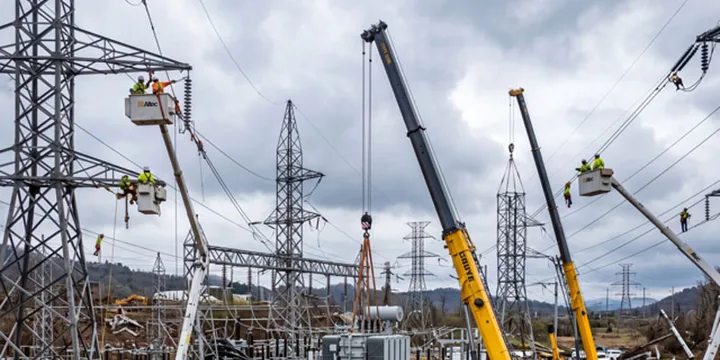
The Case for Persistent Infrastructure Identity in Power Systems
Power Systems DesignJul 1, 2026
Read Article

Addressing the infrastructure identity gap
Canadian EngineerJul 10, 2026
Read Article

Do Buildings Need VIN Numbers
PropModoApr 2, 2026
Read Article

What building owners must know about the records liability gap
FMJJul 13, 2026
Read ArticleEconomic Study Identifies a $300 Billion Infrastructure Identity Gap
Modern Contractor SolutionsApr 28, 2026
Read Article
Silent Foundations: How the Built Environment Lost Its Memory
Building.caApr 10, 2026
Read Article

The Rationale for Persistent Infrastructure Identity in Manufacturing and Robotics
Manufacturing TomorrowApr 20, 2026
Read Article
What The Former Pfizer HQ Failure Should Make You Ask About Your Facility
Facility ExecutiveAug 11, 2026
Read Article

A New Risk for Commercial Real Estate
Insurance Thought LeadershipJul 15, 2026
Read ArticleThe full record lives in the Newsroom.
Every independent publication and article from the approved archive.
Identity is the foundation everything else is built on.
Once infrastructure has an identity, everything downstream can finally reason about it.